How to Size a Solar Power System (Solar Power System Sizing Guide)
Solar Powered Rainwater Project Series
Follow the full series:
- Start here: Solar Power System Sizing Overview
- Solar Power System Sizing (The Math)
- Grid Tie vs Off-Grid Solar
- Solar Panel Tilt and Mounting
- How To Install Solar Panels On A Shed
- Buying A Great Solar Inverter Charge Controller
- Solar Battery Bank Design and Wiring
- Final Assembly and Testing
- Adding Solar Panels
- Solar water pump for well completed
In the previous post, we worked through one of the most important steps in any solar project: determining how much energy we actually need. For our rainwater system, that came out to about 2,020 watt-hours per day. This guide was through solar power system sizing step-by-step.
Now comes the part where theory turns into hardware.
How many solar panels does it take to produce that energy?
How large should the battery bank be to keep things running when the sun doesn’t shine?
And what size inverter is needed to tie it all together?
In this post, we’ll walk step-by-step through the process of sizing a complete off-grid solar power system—from panel wattage to battery capacity—using real numbers from our installation here at Roy Creek Ranch.
The goal is not just to build a system, but to build one that is reliable, efficient, and capable of running year-round under real-world conditions.
Quick Start: Estimating Your Solar System Size
If you’re looking for a quick, ballpark estimate before diving into the calculations, here are some general guidelines based on typical daily energy use:
- Small systems (lights, electronics, occasional use)~300–800 watt-hours/day → 200–400 watts of solar
- Medium systems (pumps, tools, refrigeration)~1500–3000 watt-hours/day → 600–1200 watts of solar
- Larger systems (full-time off-grid, home backup, EV charging support)5000+ watt-hours/day → 2 kW or more of solar
These are rough estimates, but they’ll get you in the right neighborhood. For reference, the system described in this post falls into the “medium” range at about 2,020 watt-hours per day.
👉 For a properly sized system that works year-round under real conditions, continue below and calculate your actual energy requirements.
Solar Panel Wattage for System Sizing
Earlier, we determined our power needs – 1300 watt-hours per day to pump water. Now we can calculate the battery bank capacity, solar panel wattage, and inverter capacity needed for our installation. Let’s start with the panel wattage. As I mentioned in the last post, the immediate goal is to power a 3/4 horsepower shallow-well pump, with a little power for the ultraviolet filter that cleans the water for house use. The filter uses 30 watts of power, so by multiplying that times 24 hours, we get 720 watt-hours. When added to the pump power consumption of 1300 watt-hours per day, our total is 2020 watt-hours per day. That’s what we have to collect from the sun.
How much sun is hitting the roof each day? Tables on the Internet show the insolation, or amount of solar radiation reaching a given area at various latitudes. The tables show that San Antonio (nearest datapoint to our home) averages 5.3 Kilowatt hours per square meter per day. Unfortunately, insolation varies during the year, and since we want our system to function even in the winter months, we’ll use the low figure for San Antonio of 4.65. That way, we will have plenty of power year around. The final factor is efficiency. No system is 100% efficient, with inverter losses, wire losses and even dirt on the panels playing a factor. It’s safe to assume an efficiency of around 67% for our system.
Now we can translate our daily energy needs into actual system components.
Formula
Daily Watt-hours ÷ Inverter Efficiency = Required Stored EnergyExample
2020 ÷ 0.92 = 2195 Wh per dayExplanation
This accounts for energy lost in the inverter when converting DC battery power to usable AC power.
Battery Storage Requirement
Since we need to pump water around the clock, we’ll have to supply power even when it’s dark. That’s where the batteries come in. There are several variables when figuring the battery bank capacity, including system voltage (12, 24 or 48 volt), watt-hours needed, days of autonomy, inverter efficiency, discharge limit, and temperature compensation. Let’s start with the watt-hours per day and inverter efficiency. We already determined a need for 2020 watt-hours per day for our pump and UV filter, but that will have to be converted from the DC voltage (12, 24 or 48 volts) to AC (120 or 240 volts). Inverters are about 92% efficient, losing about 8% of the applied power in the conversion process. This results in a formula:
Formula
Daily Watt-hours ÷ Inverter Efficiency = Required Daily Storage (Wh)
Example
2020 ÷ 0.92 = 2195 WhExplanation
This accounts for energy lost during DC-to-AC conversion in the inverter
Days of Autonomy and Real-World Conditions
What if the sun doesn’t shine for several days? Here we build in “Days of Autonomy,” or the number of days the system can go without any sun. Three days is about right for our location, but your conditions may vary. Also, temperature can affect battery performance. A battery’s rated capacity is normally stated at 77 degrees Fahrenheit, but the same battery might fall to 80% capacity at 50 degrees. Finally, a battery can be discharged to its rated capacity, but only at the cost of drastically reducing it’s life. Normally batteries are only discharged to 50% of their rated capacity to prevent damaging them. Another formula:
Formula
Daily Wh × Days of Autonomy × Temperature Factor ÷ Depth of Discharge = Required Battery CapacityExample
2195 × 3 × 1.19 ÷ 0.5 = 15,672 WhExplanation
This determines how much total energy storage is needed to keep the system running during periods of low or no sunlight without damaging the batteries.
Choosing System Voltage (12V vs 24V vs 48V)
Finally, we need to determine the battery bank capacity in Ampere-hours. What system voltage you choose will depend on several factors, but generally speaking higher system voltages (like 24 or 48 volts) are preferred for high-wattage inverters. This is because we gain efficiency in the DC wiring and can buy smaller gauge copper wire to save money. Put another way, higher voltages require lower currents to achieve the same wattage and have lower resistive wire losses. I’m going to set mine up for 48 volts using this formula:
Formula
Watt-hours ÷ System Voltage = Amp-hoursExample
15,672 ÷ 48 = 327 AhExplanation
This converts total energy storage into a practical battery bank capacity at the chosen system voltage.
Putting it all together
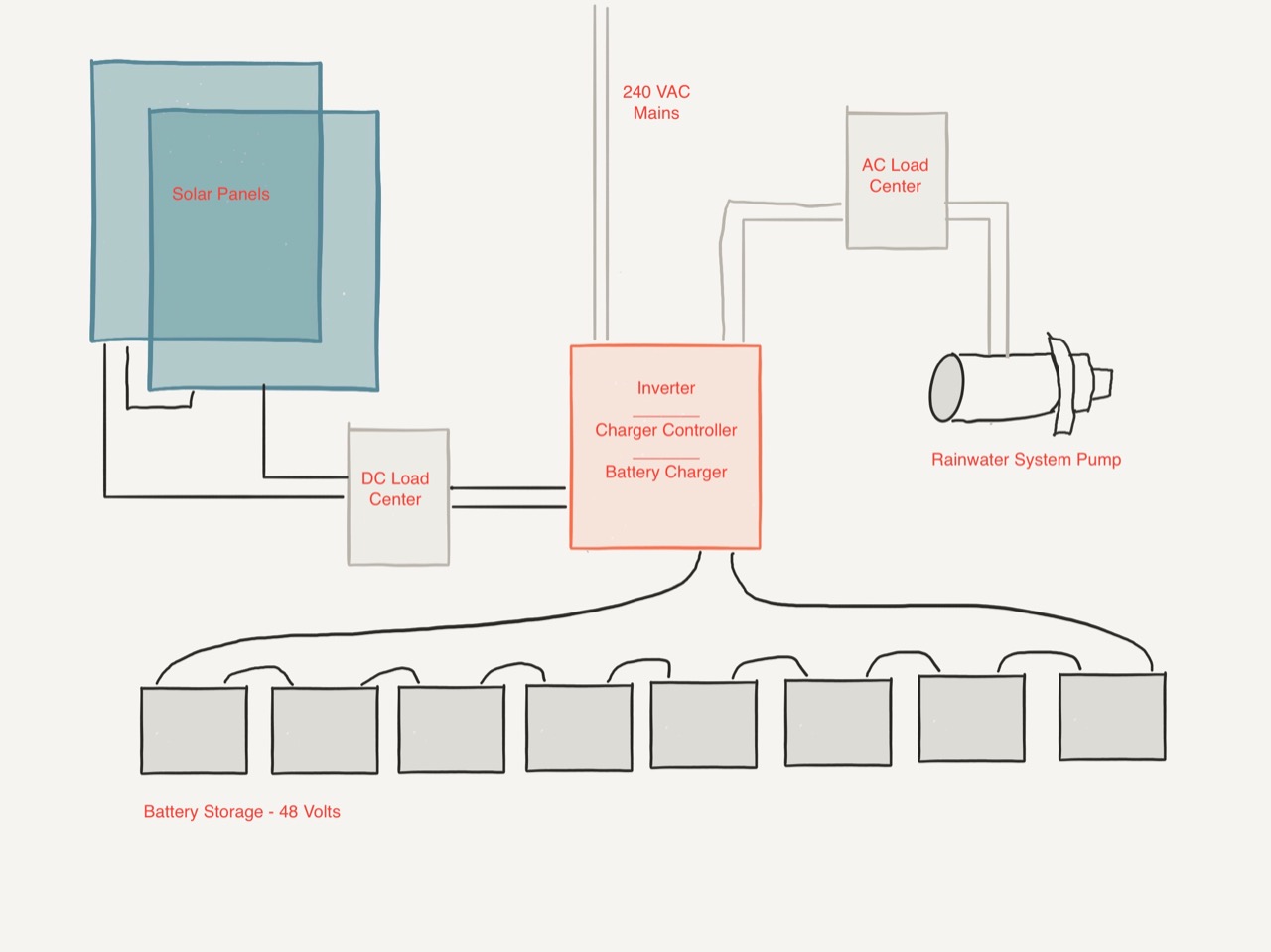
How many batteries is that? Let’s start by imagining how they might be configured. We could just get four, 12 volt, 327 amp-hour deep-cycle storage batteries, but those are expensive batteries and I would rather use the more commonly available (and cheaper) golf cart batteries. They are typically 6 volt, 190 Amp-hour. Assuming we don’t want to have more than two parallel strings (to reduce trouble with charge equalization) can we get the required capacity? Once again, some formulas:
Series Calculation
System Voltage ÷ Battery Voltage = Batteries per stringExample
48 ÷ 6 = 8 batteries
Parallel Calculation
Required Ah ÷ Battery Ah = Number of parallel stringsExample
327 ÷ 190 ≈ 2 strings
Total Batteries
Batteries per string × Number of strings = Total batteriesExample
8 × 2 = 16 batteries
Explanation
This defines how the battery bank is physically arranged to achieve both the required voltage and capacity.
Doubling that for two series strings, and we will need 16 total batteries. That’s a lot of lead.
Now we have some idea of solar panels and batteries needed for the project. In the next post, we’ll consider inverters, charge controllers and related equipment.
Solar Resilience Project Series
Follow the evolution of the Roy Creek Ranch solar system:
Phase 1 — Foundational Systems
- Solar Power for the Amateur Radio Station (2015)
- Solar Powered Rainwater Project (2017)
- 2 kW Shop Solar System (2019)
- Build a Handy 12-Volt Solar Generator with LiFePo4 Batteries (2023)
Phase 2 — Expansion & System Upgrades
- Solar Power System Upgrade (2022)
- The Really Big Lithium Battery (2023)
- Solar EV Charging — Ioniq 5 (2024)
- Inverter Upgrade for EV Charging (2025)
- Solar Garage EV Charging (2026)
Pingback:Solar Powered Rainwater Project – to Grid-Tie, or not to Grid-Tie. (that is the question) | Roy Creek Ranch
Pingback:Solar Powered Rainwater Project – Solar Panels Installed! | Roy Creek Ranch
Pingback:Solar Power Rainwater Project – Panels and Angles | Roy Creek Ranch
Pingback:Solar Powered Rainwater Project | Roy Creek Ranch
Pingback:Solar Powered Rainwater Project – Batteries | Roy Creek Ranch
Pingback:Solar Powered Rainwater Project – Final Assembly | Roy Creek Ranch
Pingback:A Solar Upgrade for the Teardrop Trailer | Teardrop Trail