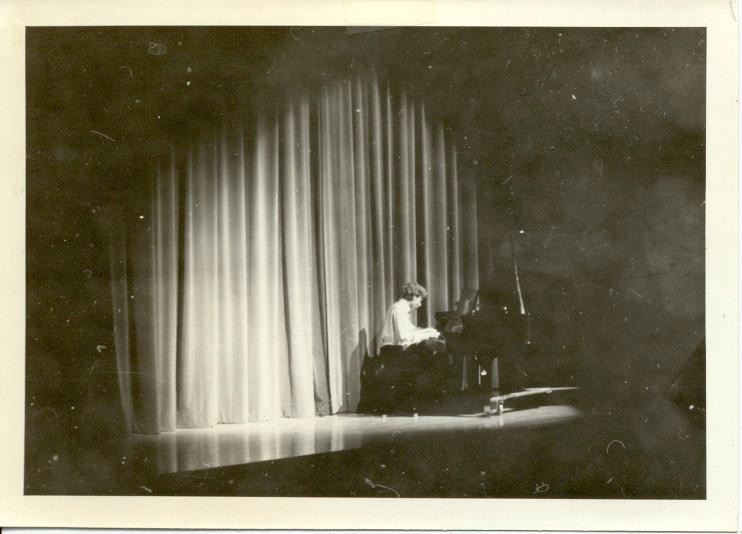
A Musical Ear
The Lonely Bull
Editor’s Note: (2026)
This article is part of the Weber Piano Project. Long before I encountered the 1893 Weber grand piano, I was introduced to music by my childhood piano teacher, Wilda Reiff. As I began researching the piano’s history, I was surprised to discover connections between Wilda, Omaha’s musical community, and several of the people who would later become part of the Weber story. This article is a remembrance of those early lessons and the teacher who first showed me how to listen, practice, and perform.
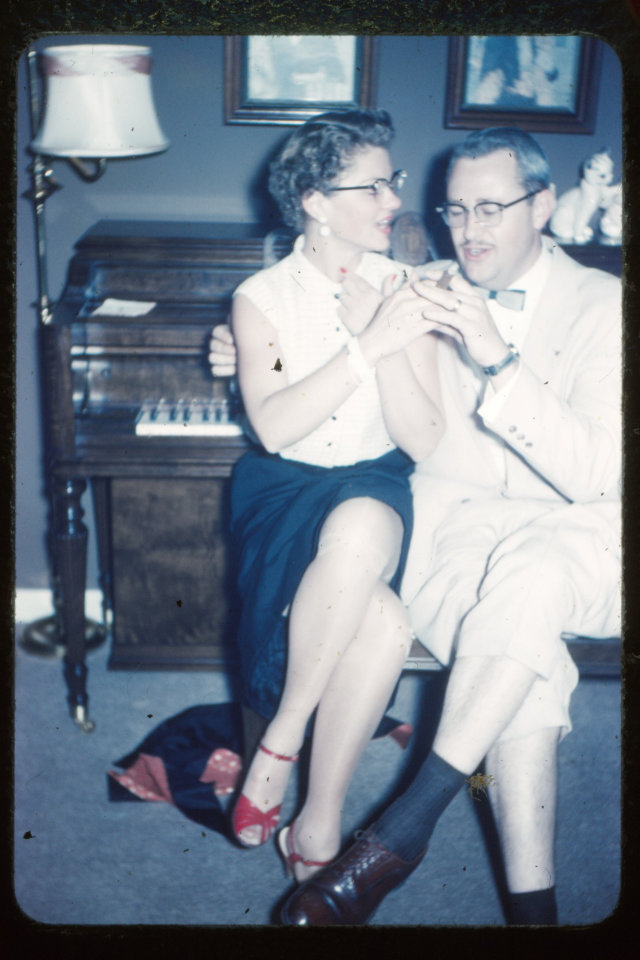
My earliest music memories center around the beautiful Mason & Hamlin spinet that sat in our living room. My mother was a fastidious housekeeper, so the mystique of the instrument was enhanced by the knowledge that this room was off-limits except when entertaining guests or playing the piano. I dimly remember my older sister and brother playing it, but I clearly remember stealing into the room to sit on the elegantly needle-pointed bench and making the piano sound. The first piece I remember playing was “The Lonely Bull,” a popular piece by Herb Alpert and The Tijuana Brass in 1962. It made it to number six on the charts that year, and I must have heard it on the radio. I managed to pick the notes out on the piano and play the melody doubled in thirds along with a credible version of the harmony in the left hand. It was easy and fun, and I wanted to learn more.
Some time after that, my mother took me to see a woman who lived in our neighborhood. I was introduced to “Mrs. Reiff,” a music teacher. She listened to me play “The Lonely Bull” and had me try a few other things on her piano and then asked me to wait while she talked with my mother. She was an imposing woman, but kind and I went outside to wait. A few minutes later they both emerged, good-byes were exchanged and we drove home. Mother told me that while Mrs. Reiff was impressed with my “ear,” she didn’t begin teaching new students until they could read — something I wouldn’t do for a year or more. It was disappointing, but I didn’t really understand the teaching process and soon forgot about it. But I still liked to sneak into the living room and play that magical instrument.
Mrs. Reiff’s Studio
Piano lessons began in the summer of 1965 between the second grade and third grade when I was eight. At first, Mother would drive me to the lesson and wait in the car while I waited in a small room outside of the studio until the previous student had finished. Before long though, I was pedaling the quarter mile or so to the Saturday lessons on my bicycle. There was a couch and chair surrounding a coffee table with pictures of a young man and women I later learned were two of her children, “Phil” and “Merle.” Both pictures were large and professional and I often wondered who they were. The coffee table had copies of various magazines, including ones I had never heard of like “The Etude” and “Musical America”. The door to the studio was usually open and I could see and hear the lesson that preceded mine.
Eventually, it was my turn and I went into the studio and sat at an upright piano. Calling it a studio seems a bit grandiose now, since it was pretty small and just barely contained two upright pianos with a narrow aisle between them and a larger grand piano in the corner. The keyboards were not more than three feet from each other, with just enough room for a bench. Only two pianos could be used at one time — either both uprights or an upright and the grand piano. The remaining corner contained a tall cabinet with several doors from which Mrs. Reiff extracted sheet music and method books for my study. It seemed as though she had a copy of all the music ever published and I don’t remember getting music anywhere else. A second door in the room led to what I assumed was her living room, although in all those years of lessons, I don’t ever remember seeing it.
The lessons were 30-minutes long, and passed quickly or slowly depending on how well I had prepared the previous week. There was a fascinating old metronome on the grand piano that was rarely used since she preferred to encourage accurate counting with syllables I could remember and say aloud. A 4/4 measure of quarter notes became “one, two, three, four” while 1/8-notes were “one-and, two-and, three-and, four-and”. More complex rhythms employed simpler sounds like “ta-fa-te-fe” for 16th-notes or “ta-fa-le, te-fa-le” represented 6/8 time or triplets. Her pencil was always in use, circling notes I had mis-read or adding numbers above or below notes to specify the correct fingering. From time-to-time, she would disappear while I continued to play and her disembodied voice would float in from the back of the house with corrections — “That’s an ‘e-flat’ in the left hand, not an ‘e.’” I was an exuberant player and liked rambunctious pieces and would be admonished for “pounding” on the piano. When the correct fingerings had not yet penetrated my practice, I was advised to learn them and not depend on “Too much pedal” to “slop” through difficult passages. I was required to practice at least 30 minutes a day and on weeks when I felt prepared, I looked forward to riding my bike to Mrs. Reiff’s house, but lessons following a week of poor preparation could be miserable. Although usually kind and supportive, she could be frightening when the lesson time had been wasted.
Learning to Perform
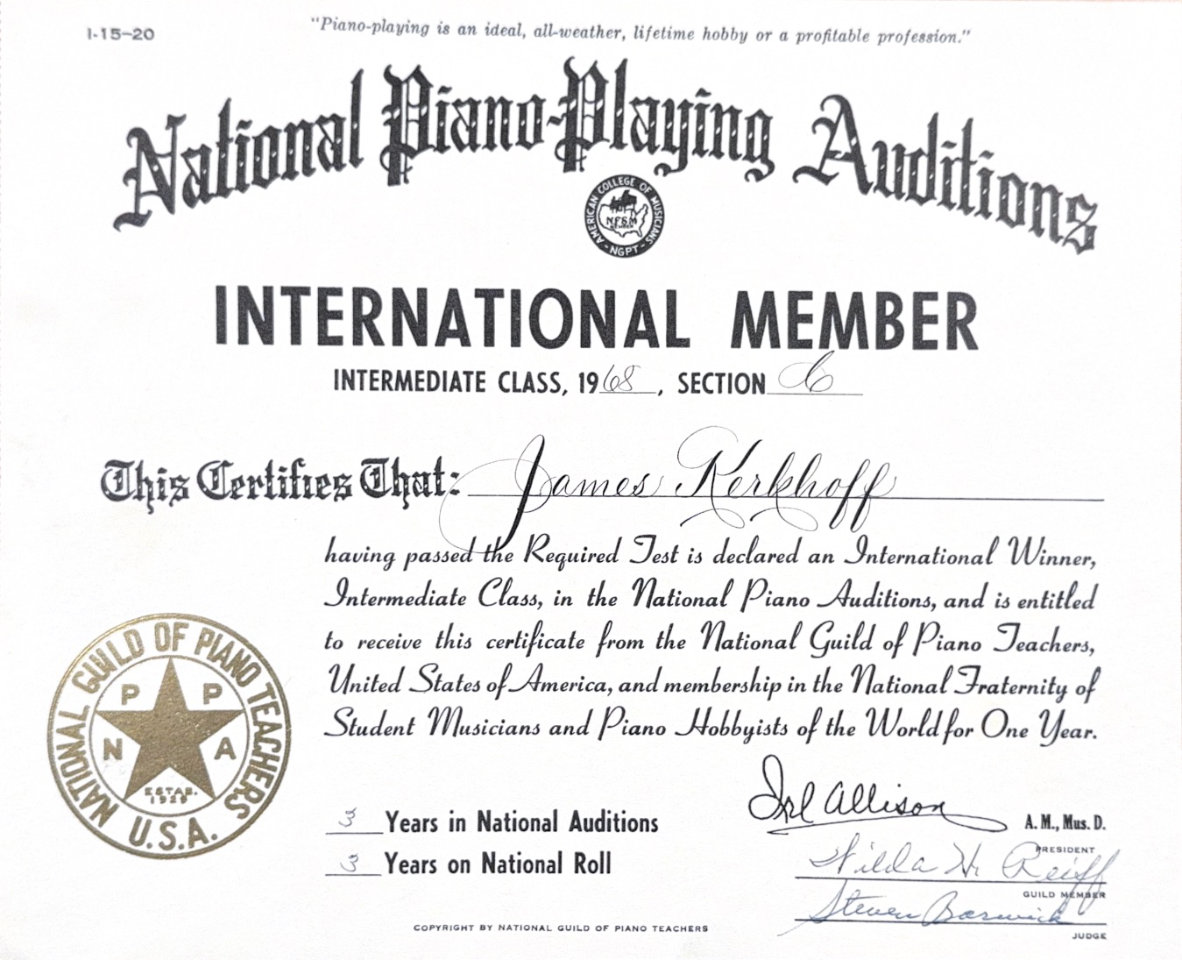
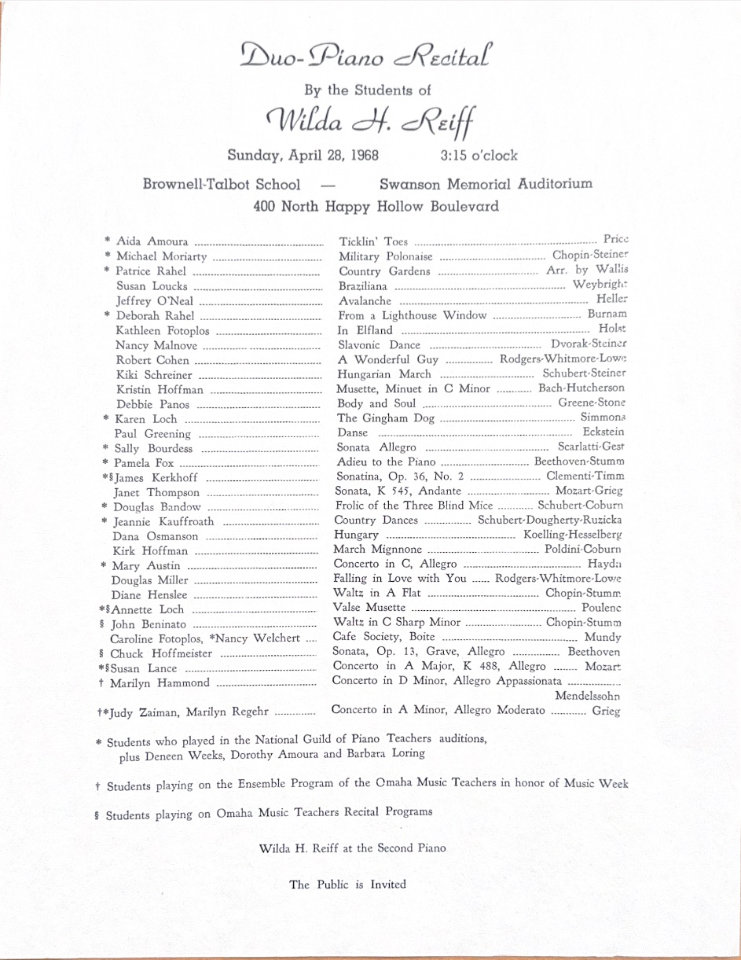
I must have progressed rapidly because Mrs. Reiff recommended I play for the National Piano Guild Auditions in the spring of 1966 — not quite a year after beginning my study. Sponsored each year by the National Guild of Piano Teachers, the auditions are a measurement of progress for piano students of all ages. They are conducted in private, with just the student and a well-qualified musician as judge. At the time, the “National” level required a program of 10 memorized pieces, selected by the teacher and student. I don’t remember much about the experience other than feeling it was a solemn event, and that it was important to do well. Because of my relative inexperience, the pieces were short and it was over with very quickly. Mrs. Reiff also had a recital for her students in May of each year. That first year we performed in the Brownell-Talbot Swanson Auditorium— part of an exclusive private school in Omaha. I was at the head of the program and played a Minuet, Prelude, March and Musette by Bach and arranged by Henderson. I imagine it went well, but I don’t have any specific memories of the event.
The following year stands out though. I was in the 4th Grade and Mrs. Reiff impressed me with the importance of the coming Guild auditions. She was especially anxious for me to do well because her teacher, Alice Davis-Berryman was to be the judge. I had worked hard all year and felt prepared, although I remember feeling some anxiety. The audition was more memorable than most. It was held at the Schmoller-Mueller Music Company in an old building in downtown Omaha. It had a narrow storefront and several stories above street level. I was directed to an upstairs floor and remember what seemed like a long walk from the front of the building, through the narrow building to a large room, empty, except for a grand piano and a table where Mrs. Davis-Berryman sat. The piano and the table seemed to be in pools of light in an otherwise darkened room. I also remember feeling relief when it was over.
Lessons Beyond Music
All serious piano students go through experiences like this as they progress. Later on, when I studied piano in college, it became all-important since the audition, or Jury as were then called, would determine the student’s progress for the year and their fitness to continue with their studies. A failure in these juries usually meant the end of the piano student’s classical performance career. I had no idea how important these auditions would become, but Mrs. Reiff was preparing me for the pressure of auditioning — something all working musicians do often. The experience of performing in a pressure situation was valuable in my other professional pursuits and I am still grateful for that early preparation today.
Continue Exploring the Weber Piano Project
What began as a simple email eventually grew into a larger story involving music, history, craftsmanship, and the people connected to an 1893 Weber grand piano. Visit the Weber Piano Project hub page to explore the full project.