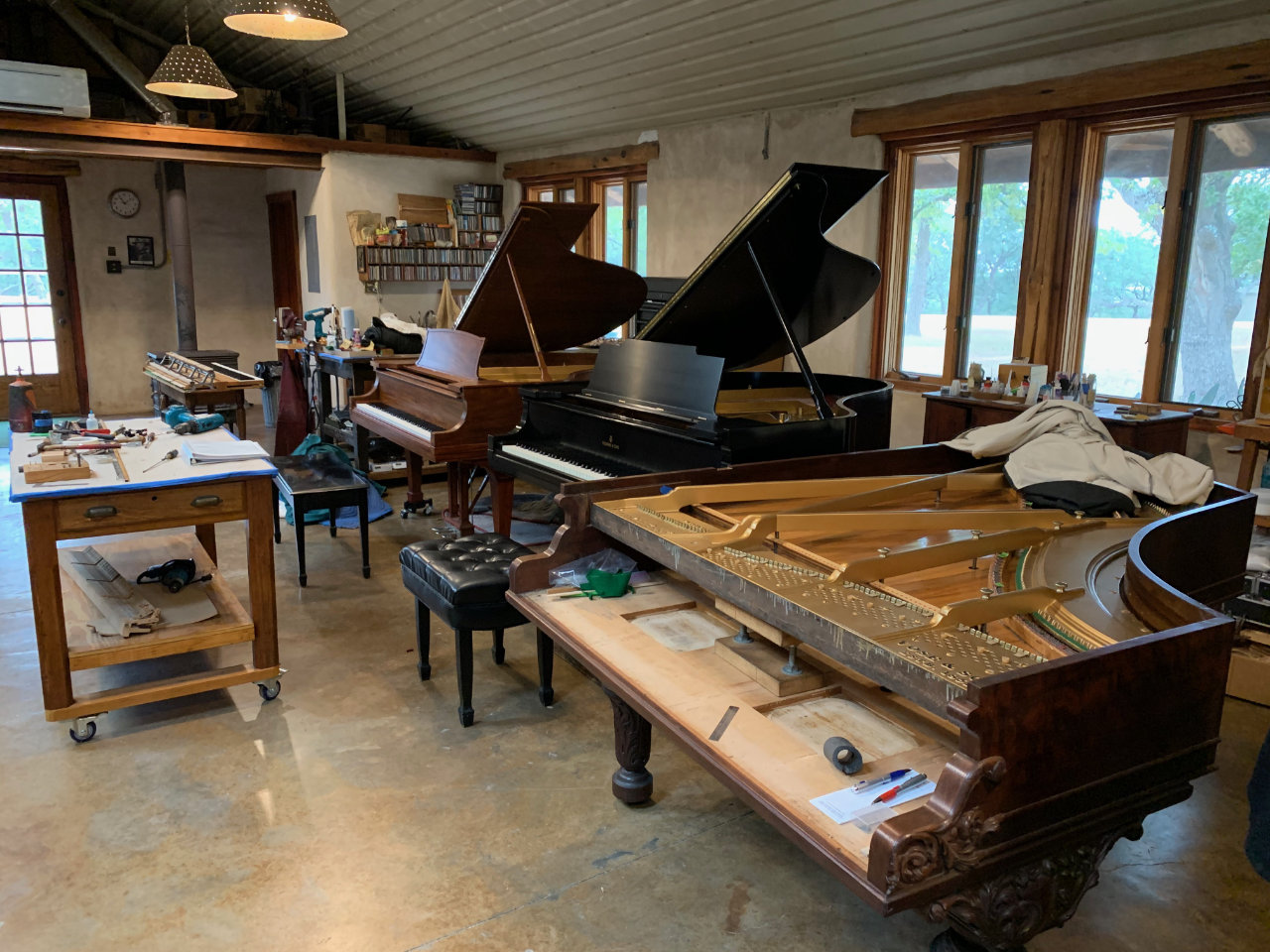
I Didn’t See It Coming
Editor’s Note (2026)
When this article was originally written, I thought I was simply documenting the restoration of an old piano. I had no idea that the instrument would eventually lead me into Omaha history, remarkable friendships, and a much larger story. Looking back, this was where the journey truly began.
It began innocently enough. But then these things usually do.
My friend Jack was out to tune and had just finished.
“You really ought to do something about this piano.”
This had come up before. I have two grand pianos, a 1927 Baldwin and a late 19th-century Weber. He was talking about the Weber of course, since the Baldwin had been rebuilt 10 years before.
“Jack, I don’t really have the money to rebuild a piano at the moment.”
Restoring old pianos is often worthwhile, but very expensive since most to the work is done by hand. I purchased the Baldwin in about 2008 with the idea of using it while I had the Weber rebuilt, but the rebuilder and I had decided that the Baldwin would be a better instrument. So the immediate need of a good playable instrument had won out over restoring a Gilded Age jewel.
I bought the Weber when I was in college after winning a concerto competition. One of the prizes was an invitation to perform with the university orchestra and I needed a better instrument for rehearsal. My childhood Mason & Hamlin spinet was fine, but wouldn’t prepare me for the big night.
A few days later, I mentioned my concerns to the Music Department Chairman. He knew of a grand piano I could buy from the school for a $500 contribution to the scholarship fund. Since I was working full-time as a broadcast engineer, the money wasn’t a problem. A few weeks later the massive instrument arrived on the newly-braced floor of my bungalow.
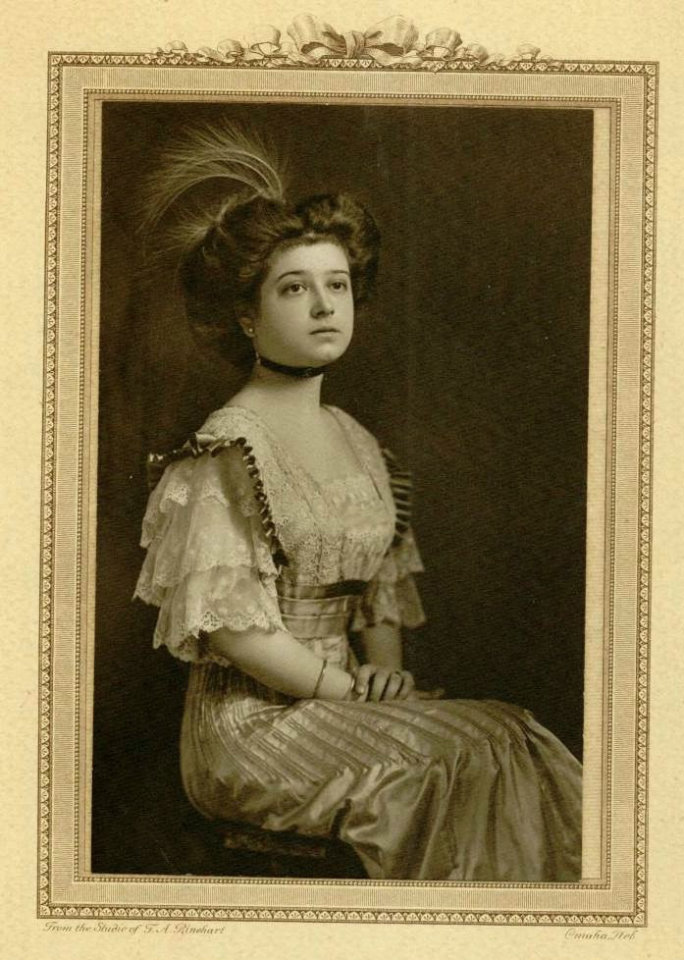
It came with an interesting story. A bequest from the estate of Miss Eugenie Whitmore, it came from Chicago during the 1893 Columbian Exposition. Also known as the “White City,” the Exposition provided a quarter of Americans their first look at electric light and other new wonders. To some, it marked the emergence of the United States from an agrarian to an industrial nation. Born in 1888, Miss Whitmore was the prominent daughter of Omaha’s first “Fine Art” Dealer, like the decorative art of today. He was a social climber and meant to advance his daughter in society any way he could. The strategy worked it seems, and she was an important part of the Omaha cultural scene for much of her life. She was a capable pianist, and often hosted visiting artists, performers and other celebrities in her home. She knew, for example, Ignace Jan Paderewski, who, if he was alive today, would be as famous as the Beatles. He toured Omaha on several occasions in the early 20th century. The real tease was the description from my piano technician-friend, Randy. He worked on the piano in her home, and a “piano scarf” covered the closed lid. Framed photos of the many famous artists she knew were on it — many of whom had played the instrument. Sadly, the artifacts were long gone, but I had fun regailing my friends with the story of the old piano and its links to the past.
There was a problem though. It had been used mainly as a prop in the Theatre Department for the last several years, and was a little beat-up. It hadn’t been tuned for years, and sounded like it was stuffed full of dirty socks. Dull and lifeless. I talked it over with Randy, and he thought a new set of strings would correct much of what was wrong with the sound. The next several weeks were occupied restringing the instrument which did really help. Other than tuning though, very little work had been done since — a span of almost 40 years.
An Unexpected Proposal
“Jim, this piano would really benefit from an action rebuild, and with a little help from me, you could do the work yourself. There’s a good book that describes the process as well.”
“Jack, I don’t have the shop space to do the work or any of the tools for that matter. “
“I think you could work at Bernard’s shop, and he’s interested in having you visit anyway. He has an instrument he would like you to see.”
Didn’t see that one coming. A chance to work with one of the best craftsman in the region, in his shop? Since retiring from my job at the University, where I managed an IT department for one of the colleges, my interest in the modern tech world had waned. I was more interested in “old-school” projects involving hand tools, fine woods and old fashioned craftsmanship. It seemed unlikely that a master craftsman like Bernard would agree to such a thing, but there it was. I had to find out. I called Bernard later on, and he invited me to his shop to see the instrument Jack had mentioned. I figured it would be better to talk about invading his space when I was there. We were invited to visit a few days later.
Meeting Bernard
As Marilyn and I drove through the Texas Hill Country to Bernard’s place on a bluff overlooking the Blanco River Valley, I was working hard to minimize my expectations. I first learned of Bernard’s work some 30 years before when I saw a beautiful instrument he had rebuilt in the old Austin Driscoll Hotel. A creation of the 19th century, it had a carved case, and was made of a rich, dark wood. A discrete card advertised the rebuilder’s name. It was just a moment in time, but it made an impression.
Later on, while working for the college, I learned that Bernard routinely rebuilt pianos for the Music School and was highly regarded by the piano technicians who worked there. The old Weber that had followed me from Omaha to Texas was on my mind when we talked of rebuilding instruments and I had fantasized about restoring the old grand piano to it’s former glory.
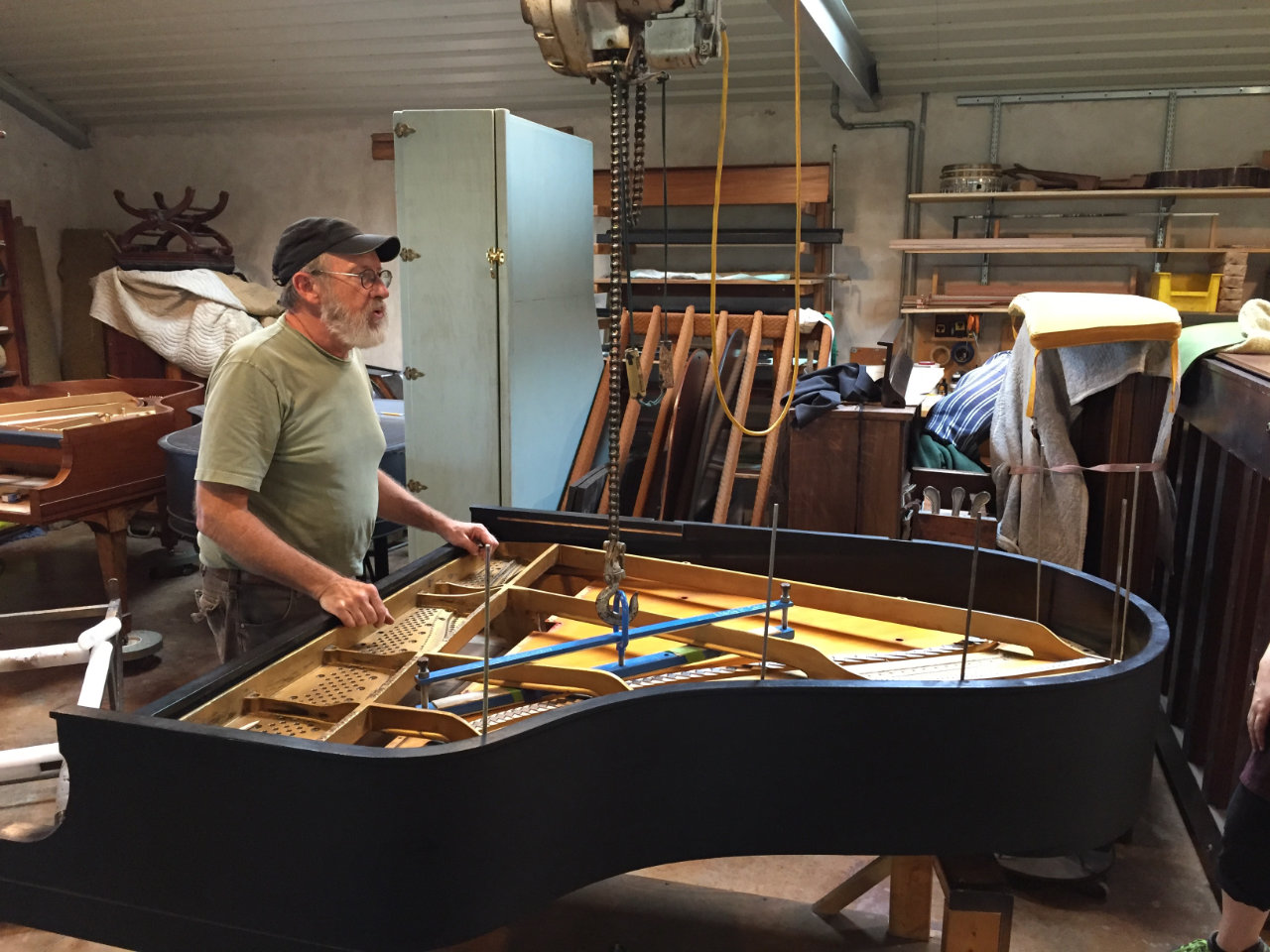
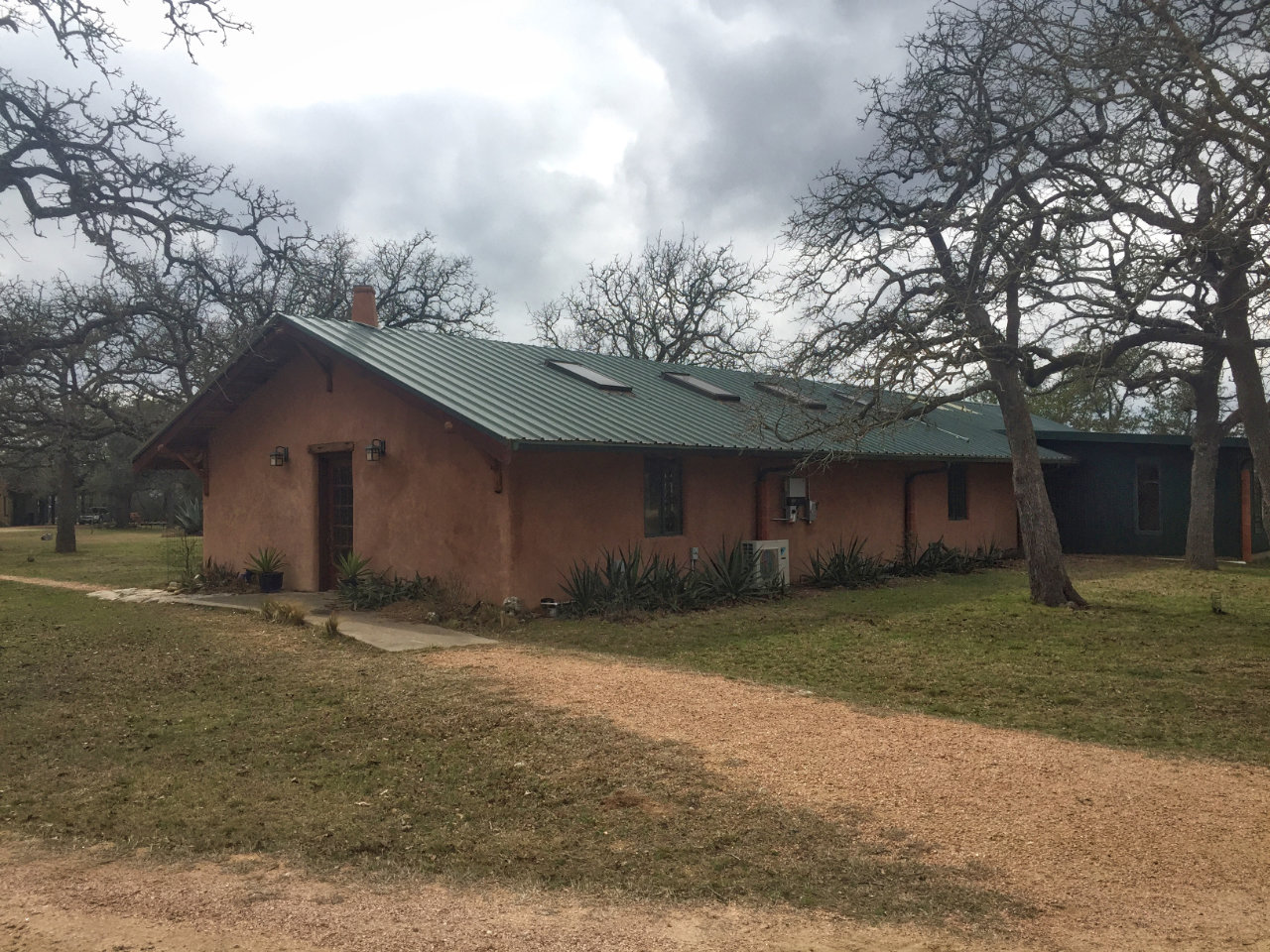
Bernard greeted us as we arrived at his shop. Just a hundred feet or so from his house it was beautifully constructed of straw-bale and adobe with big support timbers perforating the walls just below the roofline. With a roof covered in solar panels, and large rainwater storage tanks nearby, the place is a testament to sustainable buildings, water and power. The place is grand, in the truest sense of the word, with no comfort sacrificed in the service of sustainability.
We started with a shop tour, since it was Marilyn’s first visit, and it had been nearly 10 years since I’d been out. It looked much the same as I remembered it, the timelessness of an old craft imposing patterns and ways of being that don’t change much over time. He had added a covered deck off the back of the shop that overlooked the Blanco River Valley. This was another workspace, where pianos in progress could be rolled to receive their rebuilder’s attentions. Not a bad thing to pursue the meditative work of carving a sound bridge with a vista available to refresh the soul. As we toured the shop, I raised the topic.
“I’ve been thinking about rebuilding the action of the Weber with a little help from Jack. The only problem is I don’t really have the shop space or tools for such a long-term project. Jack seems to think I might be able to work here. Is that a possibility?”
“Yes, Jack mentioned the idea to me, and I think we could work something out.”
A Craftsman’s World
As we discussed the business arrangements, I began to realize I was being offered the chance to learn an intricate part of piano craft from a craftsman I admired. I always have too many projects, and the week before, rebuilding the Weber wasn’t even on the list. It would take months, and involve several thousand dollars in parts and instruction, but I could finally make meaningful progress on restoring a beautiful old piano while greatly expanding my piano and woodworking craft. It was an offer I couldn’t refuse. I needed time to think though, so I demurred while we walked to Bernard’s house to see the instrument.
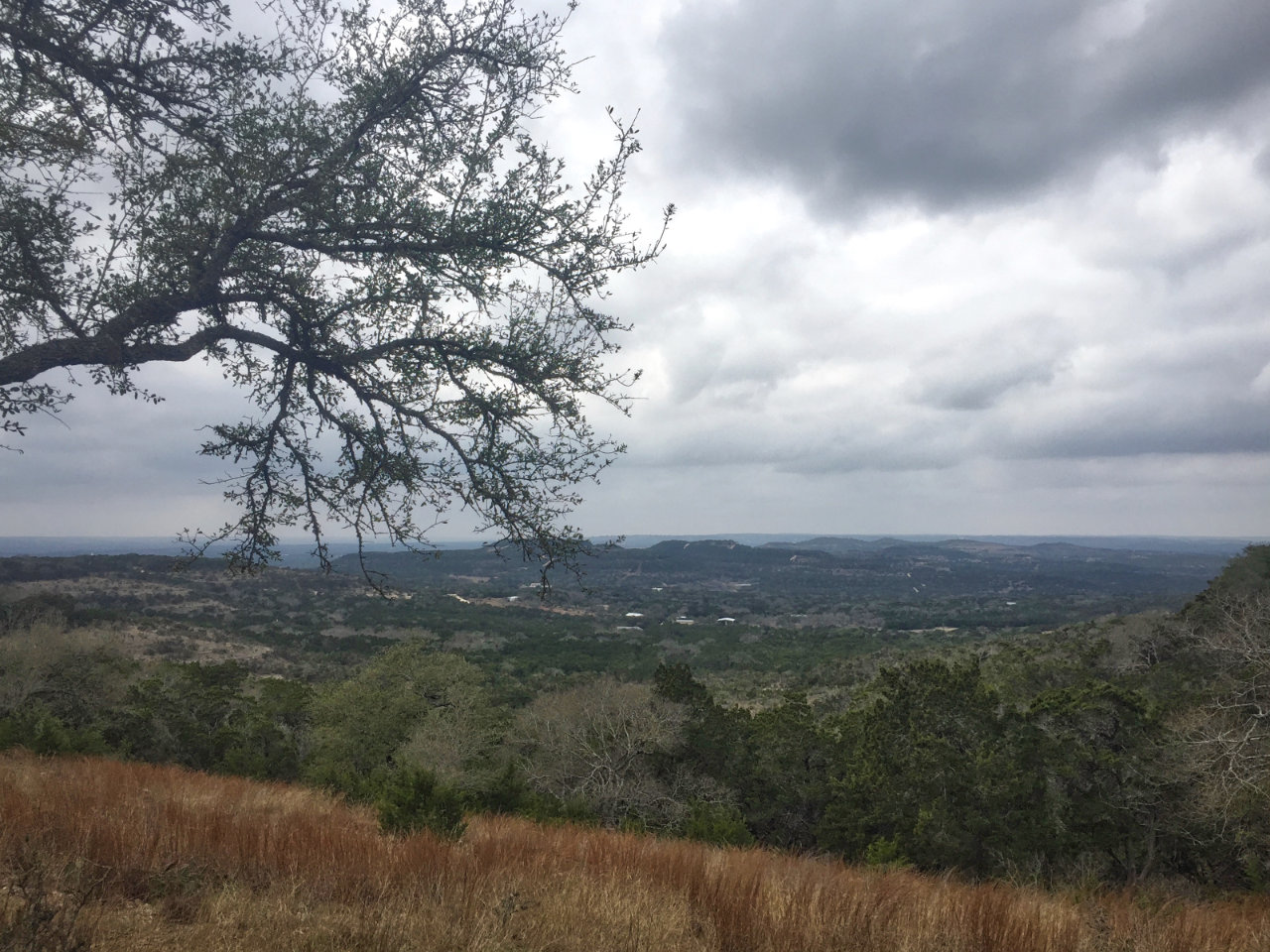
Bernard’s home is a two-story affair, built of straw bale and adobe like the shop. Massive round timbers perforate the adobe walls at various points in support of roof segments and large balconies on two sides of the building. One balcony covers a breezeway that in another time would have been called a carriage porch. Forest green roofs contrast perfectly with the adobe walls. Gardens surround the structure with a large, wooden pergola sheltering a portion of the front. Even the doors are celebrations of wood craft, with each one different than the others. The whole thing overlooks a spectacular view of the Hill Country — with terrain visible for miles away from this highest of vantage points. Bernard had clearly built a version of paradise for himself.
Once inside, we could enjoy other details of the house. A massive wooden central stairway that would have been appropriate for a large log home or ski lodge. Polished and stained concrete floors juxtaposed with white-washed adobe walls and inset windows that flood light, while shielding the occupants from the brutal Texas climate. Cool in the summer and warm in the winter. Furniture that one could imagine in any Craftsman-era bungalow from the turn of the 20th century. Rooms shaped by the curving adobe walls rather than the tyranny of the rectangle. I had seen the house some years before during the Baldwin rebuild, and fell in love with it all over again.
The Instrument
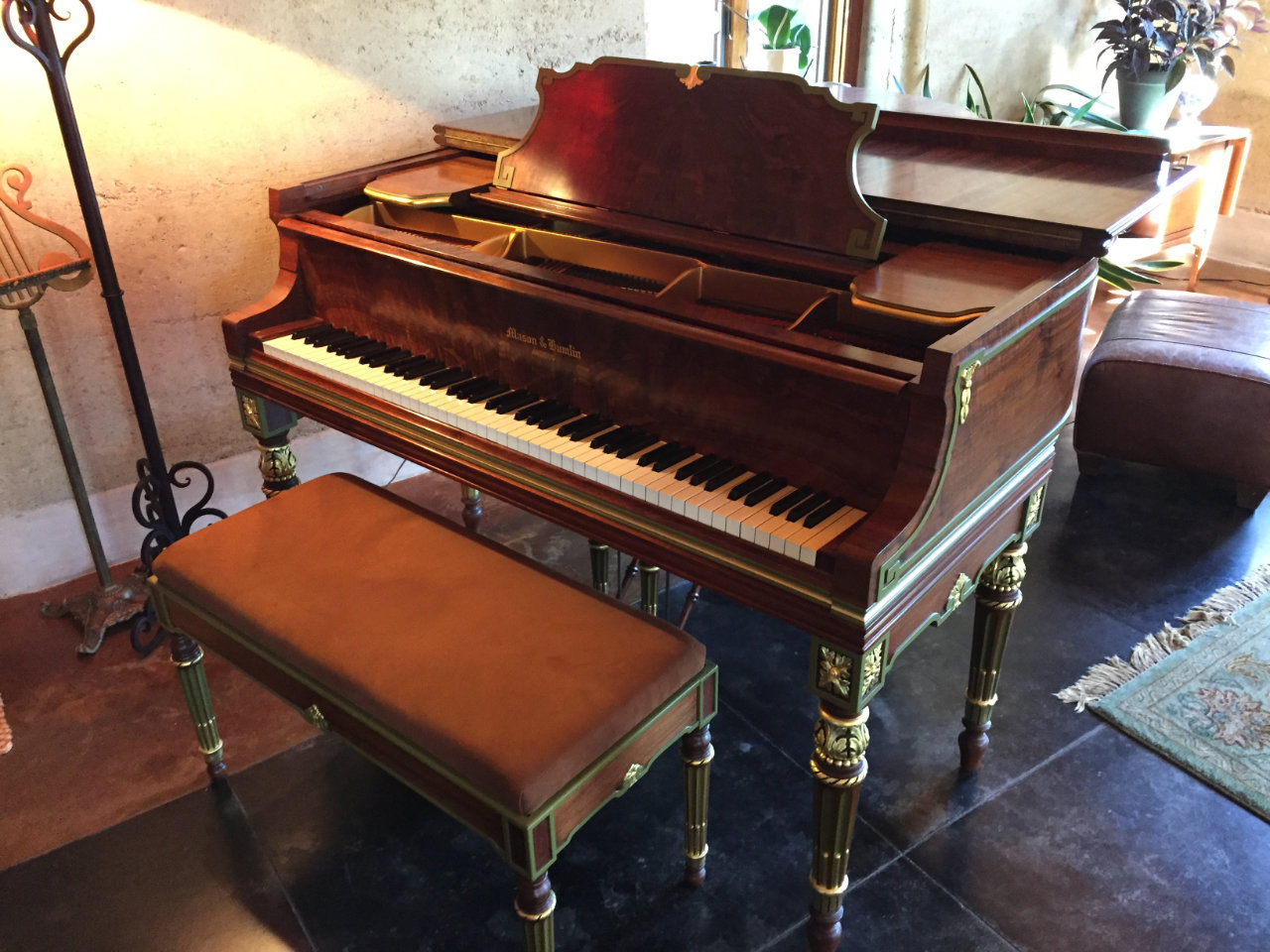
Directly in front of us was the piano. Bernard explained it had been rescued while floating in the Gulf of Mexico after a hurricane, and he had been restoring it for some time. It was a Mason & Hamlin baby grand with a carved neo-classical case and had originally been equipped with a reproducing piano mechanism, now long gone. There was a lot to take in. The art case glowed with beautifully finished dark wood and six carved legs arranged in pairs. Each carved leg had olive green painted insets. Carved leaf capitals were joined by a pediment decorated with shell and leaf medallions. All the decorations were covered in gold leaf, while the same theme outlined the lower curve of the case itself. The bench and lyre were decorated in the same fashion. The lid was open on a full stick to reveal the bronzed steel plate accented by burgundy felt mutes and cushions. The Mason & Hamlin crest was perfectly visible on the new soundboard through new copper and steel strings.
Bernard invited me to try it out, and as I sat down, I noticed the familiar Mason & Hamlin logo. Just a few notes revealed this was something special. In some ways, it reminded me of the spinet I played from childhood until college, but with the more robust feel of a grand piano. Not a heavy touch as in some grands, but responsive and capable of rendering the smallest of gestures. This is the mark of a fine instrument. The tone, while different than a 6-foot or larger piano, was still rich and full, with clear and crystalline treble. I played a little more, while Bernard and Marilyn listened nearby. I’m not a always comfortable with impromptu concerts such as this — no doubt the result of too many years of piano instruction where perfectionism is often the enemy of the merely good. I enjoyed this moment however, and began to idly wonder what such an instrument might cost.
As I finished a rendition of Gershwin’s second Prelude, I got my answer:
“I’ve been working on this piano for a couple of years now, and regard it as a retirement investment.”
He mentioned a figure one might pay for a premium sports car, and it was not surprising. It was a work of art, and there were buyers in the tech-driven central-Texas economy who could easily afford it. I had some idea of a piano’s value from my own experience buying and rebuilding the 1927 Baldwin “K”, and I could see that and more in the Mason & Hamlin.
I Didn’t See It Coming
As we drove home, I was conflicted. The romance of restoring a piece of history and hearing it sound as it did over one hundred years ago is powerful. It’s just not practical. A complete restoration would involve a new pinblock, soundboard and bridges, strings, action, and interior and exterior finishing. Easily a multiple tens-of-thousands-of-dollars project for an instrument that would have only a modest market value. On the other hand, reworking the action would greatly improve its utility, and for a much more modest investment.
Sadly, there are more good, used pianos available in today’s world than potential owners. Once the center of many American homes and symbol of refinement and prosperity, the piano competes today with the recording industry, radio, film, television and the Internet along with all the other distractions of modern life for attention.
Still, I knew in my heart of hearts I would do it.
Continue Exploring the Weber Piano Project
What began as a simple email eventually grew into a larger story involving music, history, craftsmanship, and the people connected to an 1893 Weber grand piano. Visit the Weber Piano Project hub page to explore the full project.