Winning A Grand Piano
Editor’s Note (2026)
The article below tells the story of how the Weber piano entered my life. Looking back, it was the first event in a chain of circumstances that eventually became the Weber Piano Project.
I’ve left the article largely unchanged because it captures the surprise and excitement of that moment better than any retrospective account could.
Finding My Way
As I puttered along in musical studies, I had fallen into an easy rhythm. Starting with just one class a semester, I wasn’t making much progress towards a degree, but that was ok. I had no specific goal in mind other than to satisfy the musical itch.
Each weekday was about the same. I would get up by 8 or 9 and head for campus. A breakfast in the Student Union and off to the day’s class. There was time to socialize with my fellow students and have lunch before going to work.
I had to be at the TV station by 2:15, when my shift officially started. There usually wasn’t much to do until the afternoon News cycle, so I would check into the Newsroom, look at the assignment board and plan my day. Most often, I would be scheduled to engineer a live feed during the 5 O’Clock news, with a follow-up at during the 6 O’Clock news. There was often a second feed during the weather segment, and then back to the barn.
I could get dinner and usually the evening was quiet. If I wasn’t needed until the 10 O’Clock news, I could spent the time studying. Pretty cushy.
I was also beginning to suspect that my progress at the piano wasn’t setting any records. It was hard to imagine I would be concertizing around the country or the world, so thinking about a more academic pursuit seemed wise. I changed my major to Music Theory and Composition. I would continue studying piano with Harry Payne, but focus more on my composition.
A Reality Check
There was another driver for this move. The school had sponsored a Master Class for Piano Majors with Daniel Pollack,a famous concert pianist who had played much of the music for the movie, The Competition. I had just made my decision to switch majors, but I could still participate, so I did. What stands out from that experience was not my playing for the artist, or his recommendations for me, but the answers I got to a couple of questions. I asked Mr. Pollack: “How big is your repertoire?” And “How long do you take to learn a concerto?”
The answer to the first question, “perhaps 50 or 60 concertos” was daunting, but seemed doable in the course of a lifetime career. The second question was the deal breaker though. He said: “Ideally you would like to take a year. But usually you get about a month, and I once had to learn the Barber Concerto in two weeks.” Great. The Barber Concerto is ranked by some in the “extraordinarily” or “ridiculously” difficult tier. I could see that I wasn’t equipped with that kind of facility.
I later learned that most concertizing pianists have what amounts to a photographic memory. They don’t spend any time “learning” the music, a run-through or two and they’ve got it. The real time is spent working out the physical and technical details of the piece. While I have a very good memory, approaching perfection when remembering how to reassemble a complex piece of equipment or recall a clever quote, my musical memory stops short. I can picture pages of music, but the notes are not quite visible in my minds eye. Who says life is not ironic?
Enter the Competition
About the same time, the school announced they would sponsor a concerto competition. The winner would receive a small cash prize and a chance to perform the winning work with the school orchestra in a public performance. In my musically ambivalent world, entering this competition seemed like a good idea and might even be fun. Since I had changed my major to Music Theory and Composition, there was very little chance of winning. I did want to experience the audition process though.
For the next several months, I worked hard on Gershwin’s Concerto in F. Contestants were to audition with just one section of their piece and learning the first movement seemed possible. Harry was supportive and a generous practice partner. Although a seemingly modest man and gentle teacher, he was a monster at the keyboard and even preferred playing the accompaniment.
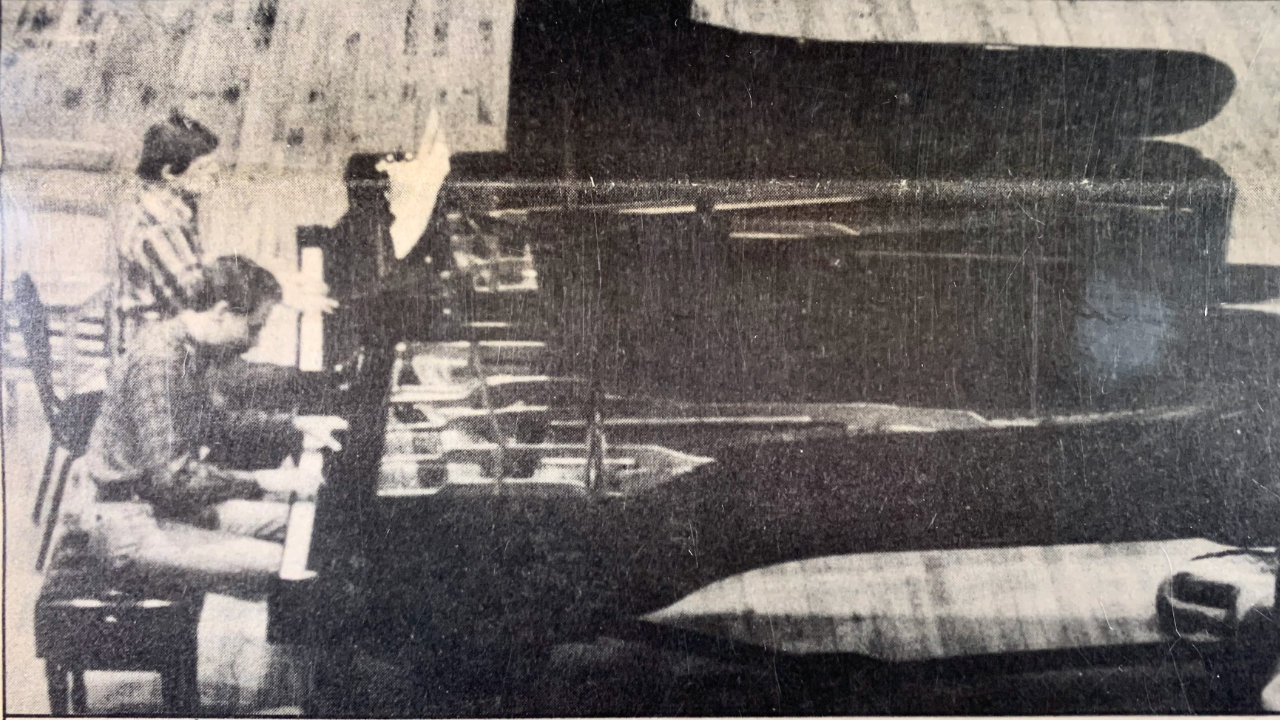
I progressed rapidly and felt my audition would be credible even if there was little chance of winning. Just learning and playing this piece with such an accomplished musician was a dream come true. I even got my picture in the campus newspaper after a stringer happened by the recital hall one afternoon and photographed us while we were rehearsing.
Oh, Shit
I don’t remember the audition at all. I’m sure I was nervous, since it was a performance situation, but it must have gone well. Because — I won the competition. Actually, there were two winners who would share the concert. After the initial euphoria wore off, I began to realize. I was going to have to perform the piece in front of an audience. Oh, Shit.
A Problem With an Opportunity
I would have several more months before the Spring performance, but another problem emerged. The Mason and Hamlin spinet piano I had loved and played since starting piano lessons, was simply not enough to develop the chops I needed for the performance. The School had practice pianos, even two reasonable Yamaha grands, but they were always busy. And, not being a performance major any longer, I didn’t get priority scheduling. I needed the regular challenge of a real grand piano.
Enter the Weber
At this point, fate stepped in. I was asked to visit the Department Chair, Roger Foltz. He saw me in his office a few days later, and had heard of my practice dilemma. It turned out there was a grand piano on the Music Department’s inventory that had been a gift to the University and was declared surplus. For a small donation to the scholarship fund, it could be mine. He recommended I go look at it in the Theatre Department, where it was currently being used as a stage prop.
As I looked it over a little later, I could see it was very old. With its squared-off tail and carved legs, it looked like it belonged to another century. The lid was closed and scraped up from some kind of abuse (dancing on the lid?), but it still possessed a kind of quiet beauty. I opened the fall board, and played a little. The action was stiff, but serviceable. The tone was very different than what I was used to, but robust with a crystalline top end. The bass seemed a little dead, but the $500 contribution to the scholarship fund seemed like a modest asking price.
I was told the piano had belonged to the late Eugenie Whitmore, a benefactor to the University and well-known socialite and musician in Omaha. She had been born in the last century, participated in what was surely Omaha’s musical heyday, with musical friends and acquaintances from around the world. Supposedly many famous musicians from the early part of the 20th century had played this instrument.
With this, I was introduced to the central character in a long and very interesting journey.
Continue Exploring the Weber Piano Project
What began as a simple email eventually grew into a larger story involving music, history, craftsmanship, and the people connected to an 1893 Weber grand piano. Visit the Weber Piano Project hub page to explore the full project.