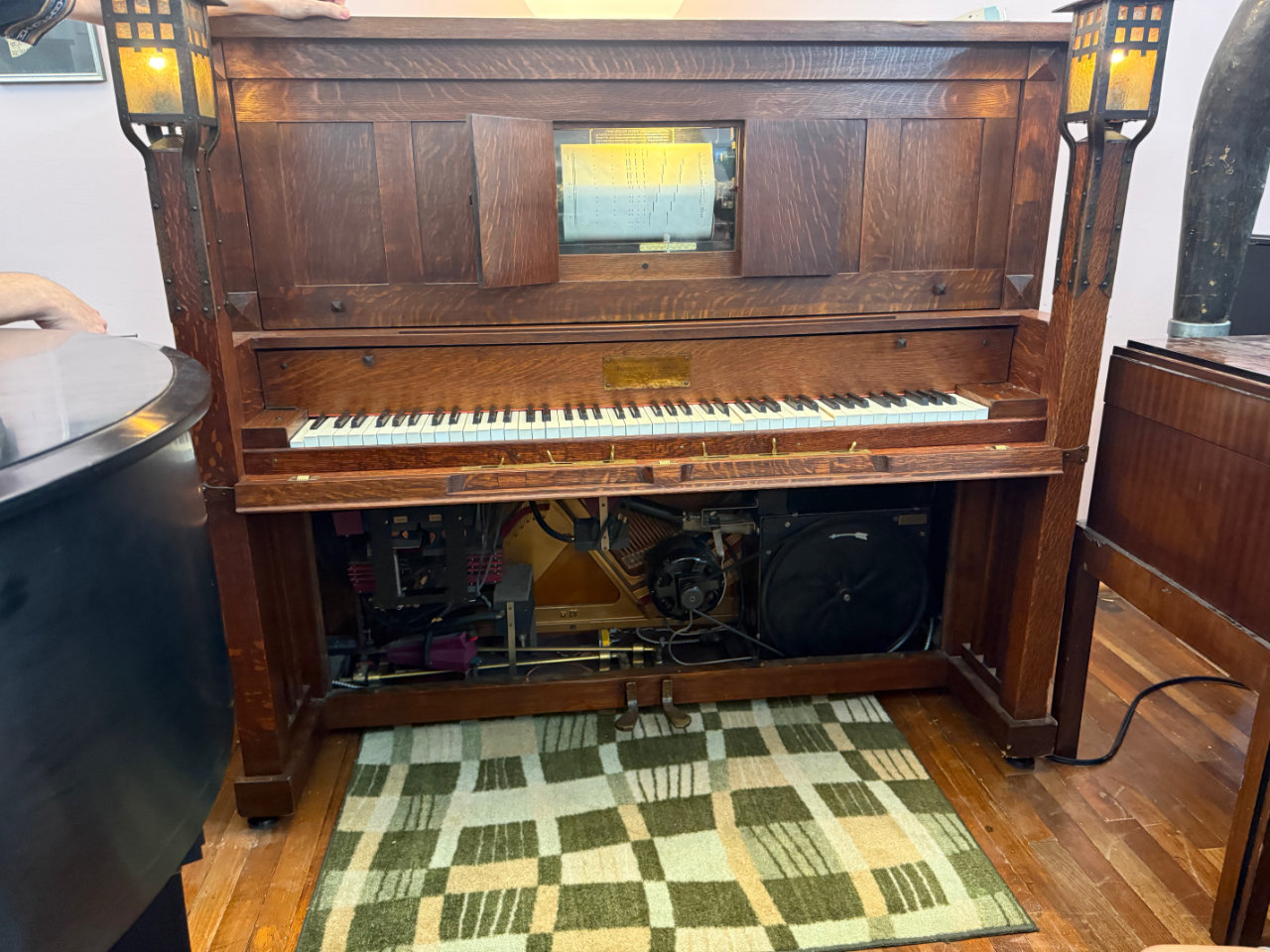
Gershwin Reproducing Piano Rolls
Editor’s Note (2026)
The Gershwin reproducing piano article originally appeared on JimKerkhoff.com. As the Weber Piano Project expanded, it became clear that reproducing pianos belong within the larger story of music, craftsmanship, and musical history at Roy Creek Ranch.
I’ve always had an interest in George Gershwin. A friend who knows this got me The Gershwins (copyright 1973) by Robert Kimball and Alfred Simon for Christmas, and I’ve been enjoying it. I read it when researching my thesis 40 years ago, and had forgotten how interesting it is. He must have found it in a used book store, because I’m sure it’s been out of print for some time. What a treat!
There’s a lot here. The story of the Gershwins (George, Ira and the rest of the immediate family) along with a lot of photographs, a chronology of shows and their songs, an alphabetical listing of songs, a discography of original cast recordings and studio recreations, and a piano rollography.
Gershwin and the World Around Him
Part of what makes George and Ira so interesting besides the great music and wonderful lyrics, is the New York theatre and Hollywood film scenes in which they functioned. They were at the very center of American popular culture from the late teens until George’s death in 1937. Ira remained productive for decades after that, and their influence on American culture continues even today.
Down the Rabbit Hole
I hadn’t gotten through the foreword before I sensed a rabbit hole opening before me. The book mentions George White, a dancer who had appeared in the Zeigfield Follies, opening a revue called Scandals in May of 1919. Repeated periodically for several years, the Scandals were to be a big part of the Gershwin’s life. I had read about these productions and was familiar with some of the music, but had never seen any historical footage of them. Forty years before, it hadn’t occurred to me to even look — such resources didn’t exist for a college student at the time. I began to wonder if there might be footage on YouTube since it’s frequently surprising what is there. Down the rabbit hole.
A quick search on the phrase “George White Scandals” produce a few hits, mostly from 30’s films. Not surprising since sound recording for film did not come along until 1929, and that was a pretty cumbersome affair. Still, I had hoped for some silent footage of “The Great White Way” in the era, if only to get a feel for the times. There was this however:
A series of photographs and posters set to piano music from early 20’s Scandals productions. Better than nothing! It did jog another thought though.
Gershwin Reproducing Piano Rolls
Besides writing many memorable tunes, George was also a fantastic pianist. He had started his career as a song-plugger at Remick’s in New York, and years of reading and performing piano music for customers had worked their magic. Capitalizing on this skill, he recorded hundreds of piano rolls between 1916 and 1927. The earliest rolls were other’s music, but Gershwin’s compositions begin to appear in September of 1919 with Tee-Oodle-Um, Bum-Bo from La La Lucille. I began to search for these tunes and was rewarded with Swanee, a recording of Gershwin’s first national hit song:
From Player Piano to Reproducing Piano
I found videos of other composers like Cole Porter played on what appeared to be a player piano, but with a difference: there was expression! Unlike the Swanee roll, the individual notes varied in volume, and the performance sounded much more like a human player was performing the song. Here’s Frank Milne’s performance of It’s De-Lovely:
The difference is what’s known as a “reproducing piano”. Unlike the much more common “player piano”, the reproducing piano preserves the performer’s expression by storing note velocities (the force applied to each key) along with pitch and duration. It also preserves pedal actions. In other words, you are hearing the performer’s actual performance on a real instrument — not a sound recording. This is especially important for the time period because sound recording techniques were primitive, acoustically-coupled recordings. Practical electrical sound recording techniques would not come along for several more years, and high fidelity recordings we enjoy today would not be available for at least a decade. A reproducing piano is the best way to hear these recordings.
Hearing the Great Musicians of an Age
Here’s the surprising part; other composers like Faure, Grieg, Debussy, Scriabin, Rachmaninov and Jelly Roll Morton created rolls on a reproducing piano, as well as famous piano artists like Paderewski, Ravel, and Busoni. Decades, or even more than a century later, it is still possible to hear the great musicians of the age perform, and in a format that rivals what would have been heard in a concert hall of the day.
More than a century later, the remarkable thing is not simply that these performances survive, but that we can still hear something of the musicians themselves. A paper roll, a pneumatic mechanism, and a piano become a kind of time machine.
Continue the Journey
Reproducing Pianos and 19th-Century Piano Performance — explore how these remarkable instruments preserved the playing of some of the great musicians of an earlier age.
The Rabbit Hole Opens — another unexpected journey into musical history, this time beginning with an 1893 Weber grand piano and its original owner, Eugenie Whitmore.
Pingback:Reproducing Pianos and 19th-Century Piano Performance | Roy Creek Ranch
Pingback:Gershwin Reproducing Piano Rolls | Jim Kerkhoff